
Humanoid Robot Singapore: 5 Proven Ways Casbot Fixes the Manpower Crisis
A humanoid robot in Singapore is no longer a trade-show novelty — it’s becoming a practical answer to a very real problem: front-of-house and information-service roles that Singapore businesses simply cannot keep staffed. Between tight foreign labour quotas, an ageing local workforce, and rising wage costs, the humanoid robot Singapore operators are now deploying is doing a specific, narrow job well: standing at a counter, guiding a visitor, answering a repeated question, and doing it the same way at 9am and 9pm without a shift change.
This article looks at five concrete ways a humanoid robot deployment is solving that gap in Singapore right now, using Casbot — the humanoid chassis running on the Collie platform — as the working example.

Photo: Pavel Danilyuk / Pexels
Why Humanoid Robot Singapore Demand Is Rising Now
Singapore’s labour market pressure isn’t new, but it has compounded. The Ministry of Manpower has acknowledged in Parliament that AI-driven automation is reshaping the labour market, while the government works to help employers adopt it responsibly rather than resist it. That official posture — adopt, don’t avoid — is exactly why a humanoid robot in Singapore has moved from pilot project to procurement line item for facilities that run long hours with thin front-of-house staffing.
1. Covering Front-of-House Roles No One Wants to Staff Overnight
Malls, hospitals, corporate lobbies, and exhibition halls all have a common staffing headache: someone needs to be at the entrance to greet, direct, and answer basic questions, often across long or overnight hours where headcount is hardest to justify. A humanoid robot deployed at that post doesn’t need a shift roster, doesn’t take leave, and repeats the same greeting and directions with total consistency — freeing human staff for the judgment calls a robot genuinely can’t make.
2. Guided Assistance Without a Dedicated Guide
Casbot, the humanoid partner running on Collie, is built specifically as a human-interaction robot for information services, guided assistance, and front-of-house presence in public or industrial areas. In practice, that means a visitor asking “where’s the nearest lift” or “which counter handles this form” gets an answer immediately, without pulling a staff member away from a task that actually needs a human.
3. A Consistent, Branded First Impression at Every Hour
One thing a humanoid robot Singapore businesses report is a genuinely consistent first impression — the same tone, the same information, the same presence, whether it’s a quiet Tuesday morning or a packed Saturday afternoon. For retail, hospitality, and healthcare front desks where staff turnover naturally varies service quality day to day, that consistency is itself a business outcome, not just a novelty.
4. One Platform, Not a Standalone Gadget
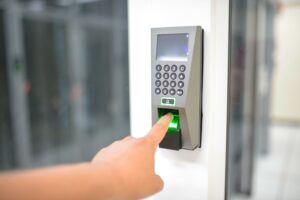
The distinction that matters for anyone actually budgeting a humanoid robot in Singapore is what’s running underneath it. Casbot isn’t a stand-alone chatbot on wheels — it runs on the same Collie intelligence layer as fixed access control, AI video analytics, and IoT sensors already deployed across a site. That means the same face-and-card authentication guarding a building’s turnstiles can ride on the robot itself, letting it badge through the same gates staff use, rather than requiring a separate access system built just for the robot.
5. A Manpower Strategy, Not a Replacement Strategy
The clearest pattern across Singapore deployments isn’t robots replacing entire teams — it’s a humanoid robot absorbing the repetitive, front-line information load so a smaller human team handles the exceptions, complaints, and judgment calls that actually need a person. That’s a manpower strategy suited to a labour market where headcount is expensive and hard to fill, not a wholesale automation play.

Photo: Angelyn Sanjorjo / Pexels
Where a Humanoid Robot Fits in a Singapore Business
- Shopping malls and retail — directions, promotions information, queue guidance at peak hours
- Healthcare front desks — routing visitors, answering repeated logistical questions, reducing crowding at reception
- Corporate lobbies and exhibitions — visitor greeting, event information, guided walk-throughs
- Industrial front-of-house — visitor check-in paired with the same access control already running on site

Photo: Samson Katt / Pexels
What to Check Before Deploying a Humanoid Robot in Singapore
- Does it run on your existing access control and video systems, or does it need a parallel system just for the robot?
- What’s the actual interaction quality — ask for a live demonstration handling real visitor questions, not a scripted showroom routine.
- How is it managed day to day — who updates its information, and how quickly can routing or scripts change when a business updates its layout or offers?
- What’s the support and maintenance model locally, given hardware servicing needs a local partner, not just a manufacturer overseas.
- Can it scale to other robot types later — a patrol robot dog, a wheeled delivery unit — on the same platform, if front-of-house success leads to wider automation plans?
Frequently Asked Questions
Is a humanoid robot in Singapore only useful for large enterprises?
No — the manpower pressure driving adoption (thin overnight staffing, rising wage costs, difficulty filling front-of-house roles) affects clinics, retail outlets, and mid-sized offices just as much as large facilities. Deployment scale simply matches the site.
Does a humanoid robot replace security guards or reception staff entirely?
Typically not entirely. Most Singapore deployments use a humanoid robot to absorb repetitive information and greeting tasks, while a smaller human team stays in place for judgment calls, escalations, and anything requiring discretion.
Can a humanoid robot use the same access control as the rest of a building?
Yes, when it runs on a unified platform. Casbot on Collie uses the same face-and-card authentication as fixed turnstiles, so the robot can badge through existing gates rather than needing a separate access system.
See a Humanoid Robot Running on Your Site’s Own Systems
A humanoid robot is only as useful as what it connects to. If front-of-house staffing gaps are a recurring problem, it’s worth seeing how Casbot runs on the same access control and video intelligence a Singapore site may already have in place.
Explore the full Collie robot fleet →
See how robots share access control with fixed infrastructure →