
Stranger Detection
Introducing AI Video Analytics for Stranger Detection: Our system uses smart technology to watch over your space. It can quickly spot unknown people and

Solutions · AI Solutions
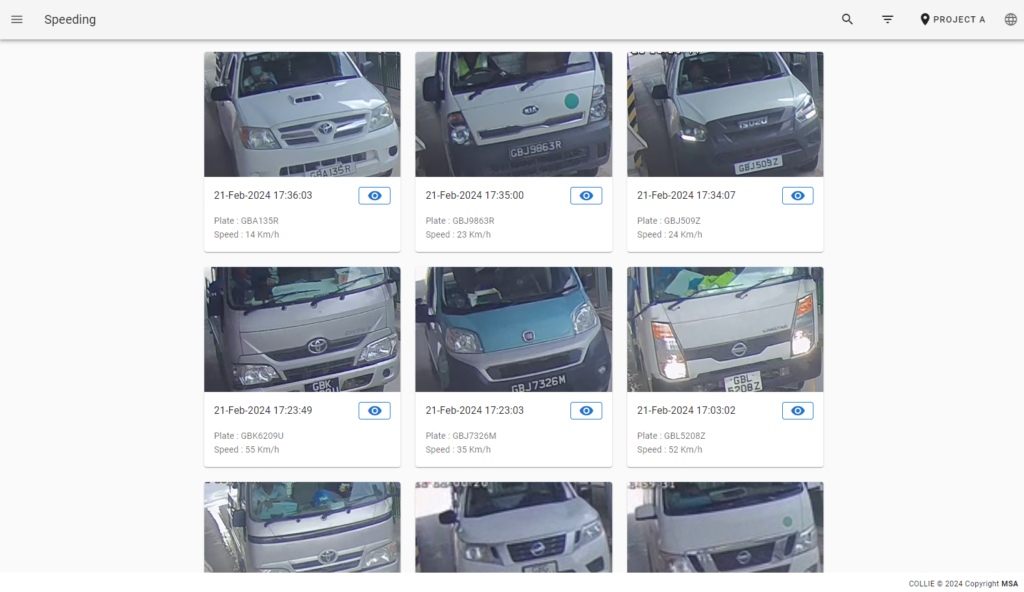
A forklift moving too fast down a shared aisle is one of the most preventable accidents on a site — and one of the hardest to catch after the fact. Speeding Detection estimates how fast a vehicle or person is moving through a defined area and flags anyone over the limit you set, in real time.
Why it matters
Forklifts, delivery vehicles, and pedestrians often share the same aisles and yards. Speed is what turns a near miss into an incident.
Vehicles moving too fast through pedestrian-shared areas are one of the most common preventable causes of workplace injury.
A speed limit sign only works if someone’s watching — without active monitoring, it’s easy to ignore under time pressure.
Without a logged event, there’s no data to bring to a safety briefing or use to coach a habitual pattern before it causes harm.
What’s inside
Draw a zone on any camera, and the system estimates how fast a vehicle or person moves through it, frame by frame.
Set a different limit for vehicles and personnel, and a different limit per zone — a loading dock and a walkway aren’t the same.
A violation triggers an alert the moment it happens — not a report reviewed after the shift has already ended.
Every event is recorded by zone and time, showing whether speeding is a one-off or a pattern worth addressing directly.
How it flows
The camera follows a vehicle or person as they move through the defined zone.
Speed is calculated from how quickly they cross the zone, compared against the limit set for that area.
Exceeding the limit triggers an immediate alert, with the event logged for later review or coaching.
One system, two kinds of limits
A forklift and a person on foot don’t move at the same pace, and shouldn’t be judged by the same number. Speeding Detection lets each zone carry a separate limit for vehicles and personnel, so an alert always reflects an actual violation for whoever triggered it.
MOD.03 · Also on the fleet
Yards and warehouse aisles change layout often, and not every one has a fixed camera watching it. A Collie robot can carry the same speed estimation on patrol, flagging a fast-moving vehicle wherever its route takes it.
Where it’s deployed
Forklift lanes running alongside pedestrian walkways and picking areas.
Open yards where trucks and mobile equipment move between staging areas.
High-traffic zones where vehicles reverse and manoeuvre near ground staff.
Site vehicles and machinery operating close to workers on foot.
It estimates vehicle speed from camera footage across a monitored stretch – such as a site road or loading yard – and flags vehicles exceeding a set limit.
Yes, it commonly works alongside ANPR & Vehicle Recognition, so a speeding event can be tied directly to a specific vehicle’s plate number.
Yes, thresholds are configurable per road segment or zone, so a loading dock and a main site road can each have limits appropriate to that area.
It’s used on industrial and construction sites to enforce internal speed limits and reduce the risk of vehicle-related incidents around pedestrians and equipment.
Speeding events are logged per vehicle over time, so recurring violations by the same plate can be reviewed rather than treated as isolated incidents.

Introducing AI Video Analytics for Stranger Detection: Our system uses smart technology to watch over your space. It can quickly spot unknown people and
This feature is new and rolling out to early sites. Tell us about the area you’d want to monitor and we’ll be in touch about early access.