If manpower shortage is on your desk this quarter, you’ve probably already looked at a security robot in Singapore as an option not out of novelty, but because guard headcount is getting harder to fill and more expensive to keep filled. This article breaks down the real cost comparison between a human guard rotation and robot dog patrol in Singapore, what autonomous patrol robot cost actually looks like against that, and where the ROI case is strongest.
This isn’t a “robots vs humans” debate, it’s a cost and coverage model for operations and security directors deciding where to put next year’s security budget.
The Real Cost of a Human Guard Rotation
A single guard only covers one shift. To keep a post staffed 24/7, you need a rotation — typically three to four guards per post once you account for shift coverage, rest days, and relief staffing during leave or MC.
Under Singapore’s Progressive Wage Model (PWM), the mandated minimum basic wage for a full-time Security Officer in 2026 is $3,090 per month — and that’s before employer CPF contributions, shift differentials, agency margin (if outsourced), uniform and licensing costs, and annual wage increases that are built into the PWM schedule rather than discretionary.
Run that basic wage across a 3–4 person rotation for one 24/7 post, and you’re typically looking at an all-in annual cost well into six figures (SGD) once CPF, overtime, and agency fees are layered on before counting the cost of guard turnover, retraining, and the inconsistency that comes with rotating personnel across a hazardous site.
That’s the baseline most operations directors are quietly trying to solve for not because guards aren’t valuable, but because the unit economics of pure headcount get harder every year the PWM schedule steps up.
What a Robot Dog Adds to the Coverage Model
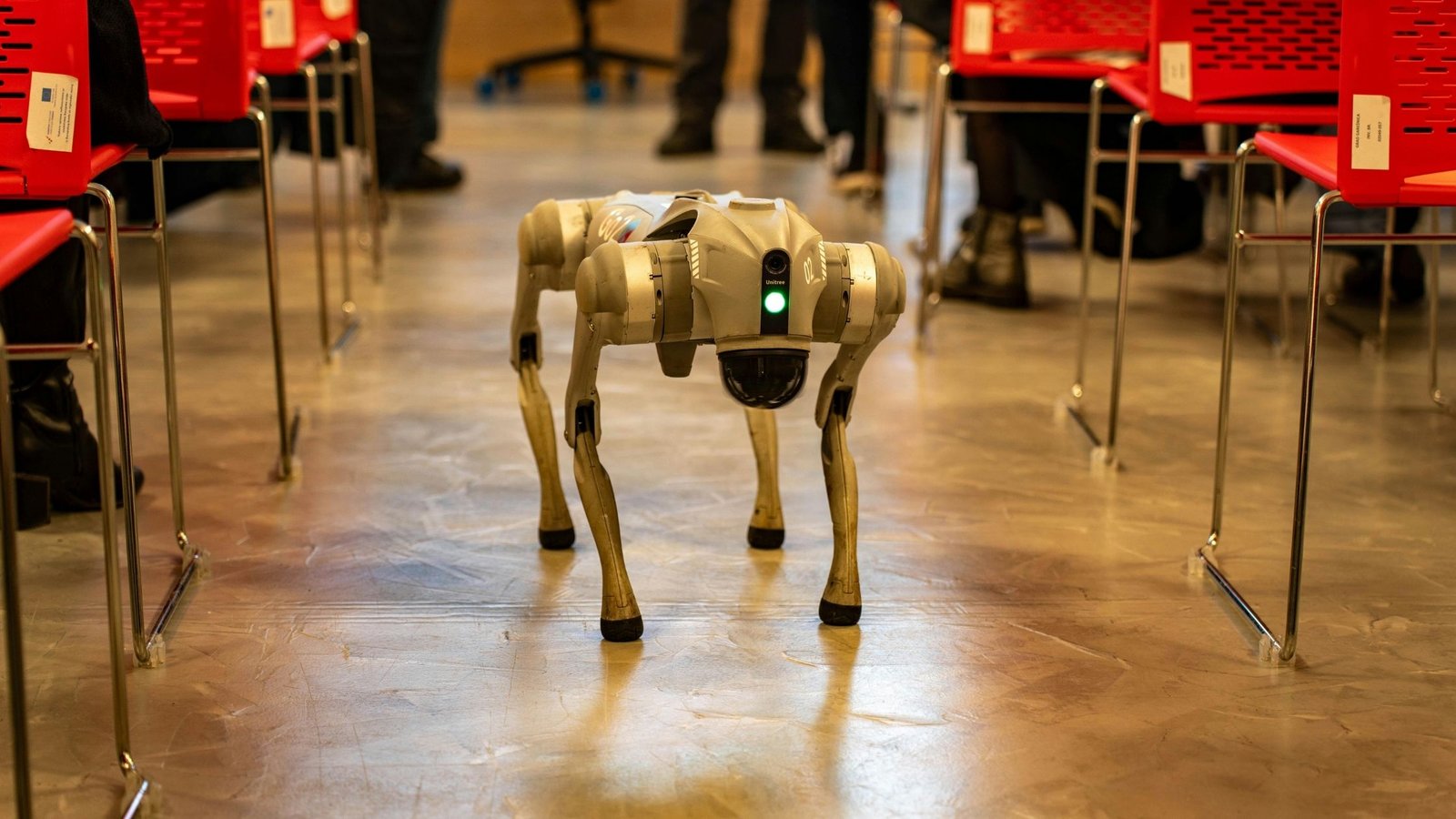
A patrol robot dog doesn’t replace every guard function — it replaces the parts of the job that are repetitive, continuous, and don’t require human judgment calls at the perimeter. That’s specifically:
- 24/7 autonomous patrol along a fixed or dynamic route, without shift handovers, rest days, or relief staffing gaps
- Thermal and infrared detection, catching heat anomalies, equipment overheating, or a person in an unlit or restricted zone that a visual-only guard round might miss
- Consistent inspection quality — the same route, the same checks, every single time, with no variance from fatigue or shift changes
- Safe operation in hazardous zones — confined spaces, high-heat areas, or locations with gas or radiation exposure where sending a human on repeated rounds carries real risk
The robot is a cost against a specific line item: continuous, repetitive patrol coverage — not a full substitute for a guard’s judgment during an active incident. Most sites that deploy this well keep a smaller human team for response, escalation, and access control decisions, while the robot absorbs the repetitive patrol load that was previously eating guard headcount.
Cost Structure: Guard Rotation vs Robot Dog Investment
| Human Guard Rotation (24/7 post) | Robot Dog Patrol | |
|---|---|---|
| Cost model | Recurring monthly wage × 3-4 headcount, rising annually under PWM | Upfront investment, then largely fixed operating cost |
| Coverage consistency | Varies by shift, fatigue, and turnover | Same route, same checks, every cycle |
| Hazardous area exposure | Human physically present | Robot absorbs the exposure |
| Scaling to a new zone | Requires hiring and onboarding more guards | Extend patrol route or deploy an additional unit |
| Detection capability | Visual, dependent on individual attentiveness | Thermal/infrared detection built in, consistent regardless of time of day |
The pattern that shows up across deployments: guard cost is recurring and rises every year under the PWM schedule; robot cost is front-loaded, then largely fixed. The crossover point — where cumulative guard cost overtakes the robot investment — typically lands somewhere in the first one to two years of continuous 24/7 deployment, depending on how many guard shifts the robot is genuinely offsetting versus supplementing. For an exact figure on your site, this needs your specific patrol footprint and current guard headcount — which is exactly what a Collie needs assessment is built to calculate.
Where the ROI Case Is Strongest
Robot dog patrol isn’t a universal swap-in for every guard post. It makes the strongest financial and operational case in specific conditions:
- Hazardous or restricted-access zones — confined spaces, high-heat plant rooms, radiation or chemical exposure areas — where reducing human presence is a genuine risk reduction, not just a cost play
- Large industrial or logistics sites with long perimeter or multi-building patrol routes that currently require multiple guards walking fixed rounds
- Sites already running MOM WSH-driven inspection routines, where a consistent, logged patrol record strengthens the audit trail for safety compliance
- Operations already struggling to fill guard headcount, where the robot isn’t replacing a fully-staffed team but filling a gap that would otherwise go unpatrolled
If your site runs a single, low-risk static post with light patrol needs, a guard rotation may still be the simpler and more cost-effective option — the ROI case sharpens as patrol complexity, hazard exposure, and site size increase.
One Platform, Not a Separate System
The strongest version of this isn’t a robot bought in isolation — it’s a robot running the same intelligence layer as the rest of your site. Collie’s Robot Dog (LimX) runs the same access control, video analytics, and IoT sensor modules used across fixed Collie deployments, so a patrol detection, an access event, and a sensor alert all land on the same dashboard your team already uses — not a separate app for the robot and another for everything else.
That matters for the business case too: you’re not buying a novelty robot, you’re extending an intelligence layer you may already have running on fixed cameras and access points, onto something that can walk the site.
Get a Cost Breakdown for Your Site
Every site’s guard-to-robot ROI math is different — it depends on your current headcount, patrol footprint, and hazard profile. If manpower shortage and rising guard costs are already on your radar, it’s worth seeing what a robot dog deployment would actually offset on your site.
See the Robot Dog (LimX) in detail → Read why operators are investing in humanoid robotics now →